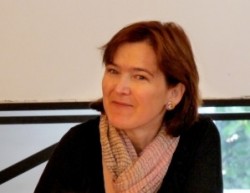
Cynthia Lam

Cynthia Lam undertook a research-focused internship with the Global Compact Cities Programme in late 2011/early 2012, where she explored sustainability initiatives in Melbourne local government. Her research internship led her to undertake a minor thesis as part of her Masters degree. Her thesis explores the theory of ecological modernisation and argues its theoretical shortcomings and weaknesses when it informs environmental policy making, especially concerning the broad task of working towards more sustainability. Her thesis, ESD: A Basis for Ecological Modernisation of the Planning Permit System in Victoria?,uses a case study of the SDAPP program initiated by local governments in Victoria.

Cynthia completed her Master of Social Science (Environment and Planning) at RMIT University in 2013. She is also an urban planner certified with the Planning Institute of Australia (PIA). She is currently coordinating a three-year research project in the Central Goldfield Shire in Victoria, Australia, which is investigates in the impacts of community partnership and leadership involvement in a community arts projects on the culture of the Shire. Cynthia is also co-authoring a peer-reviewed journal article with Dr Andy Scerri. Using an ongoing land use dispute surrounding the augmentation of an existing electricity infrastructure in Melbourne as a case study, the article aims to contribute to theoretical discussion about how it is that different groups justify their arguments that the actions they promote might contribute to the ‘common good’.

Her research interests includes urban and planning theory, sustainable strategic planning, urban design and health, housing and community development.

Similar Posts

  • Nick Rose

    Dr Nick Rose is a specialist in the emerging field of sustainable food systems and the related fields of food sovereignty and food security. Nick was awarded his PhD in Political Ecology from RMIT University for investigating the transformative potential of the global food sovereignty movement. During and after his PhD, he co-founded and coordinated...

  • Tony Dalton

    Tony Dalton is a Professor in the Centre for Urban Research at RMIT University. Following appointments in senior leadership positions at RMIT including Deputy Pro Vice-Chancellor Research and Innovation in the College of Design and Social Context (2004-2010) and Chair of Academic Board (2009-2010), Tony returned to research and teaching in 2011. He is currently...

  • Joana Correia

    Joana Correia is an Architect with over 7 years of broad ranging international professional architectural experience. Since completing her Bachelor in Architecture at Universidade de Lisboa in Portugal, Joana has held positions in both large and small architectural and engineering offices in South Africa, Mozambique and Portugal. She has a Master of International Urban...

  • Alberto Posso

    Alberto Posso is an Associate Professor of Economics at the International Trade and Development Research Group in the Royal Melbourne Institute of Technology (RMIT), where he has been employed since 2009. Alberto holds a PhD in Economics from the Australian National University (ANU) with specializations in labour economics, development, and applied econometrics. His work aims...

  • Mireia Belil

    Mireia Belil is a geographer who studied at the Universitat Autònoma de Barcelona and the University of California, Berkeley. Since 1986, Mireia has worked as a researcher and consultant specialising in development and urban policy issues, especially in defining territorial, social and cultural strategies, and cities’ international relations. In 2002, Mireia joined the Universal Forum...

  • FPAA

    FPAA Pan American Federation of Architects Associations (Federación Panamericana de Asociaciones de Arquitectos – FPAA) The Pan American Federation of Architects Associations is a nonprofit organization which aims to unite Architectural organizations from all parts of North, South and Central America including the Caribbean across all racial, religious or political boundaries. The FPAA was started...